WIRRAWAY CA-5
Few aircraft in history command as much respect as the Avro Lancaster. Designed in Britain during the darkest days of the Second World War, this heavy bomber would go on to become the backbone of RAF Bomber Command—and a symbol of precision, power and perseverance in the Allied war effort.
Born from the shortcomings of the twin-engine Manchester, the Avro Lancaster heavy bomber was engineered for endurance and payload. Its four Rolls-Royce Merlin engines enabled it to carry the heaviest conventional bombs of the war, including the 12,000 lb “Tallboy” and the 22,000 lb “Grand Slam.” With the capacity to fly long distances, return under fire, and deliver devastating precision strikes, the Lancaster bomber changed the strategic landscape of aerial warfare.
More than just a machine, the Avro Lancaster aircraft became a legend. Crews nicknamed it “Lanc” or “Lankie” as a mark of endearment. Over 7,300 were built, and together they flew more than 150,000 missions, dropping over 600,000 tons of bombs. This legacy earned the aircraft its place among the most revered of all WWII bombers.
Today, visitors to the Aviation Heritage Museum in WA can come face to face with this iconic aircraft. The museum’s own Avro Lancaster NX622—one of only 17 surviving examples worldwide—offers a rare and powerful connection to history.
A Legendary Aircraft of the Second World War
The Avro Lancaster aircraft was born from necessity and quickly became one of the most successful heavy bombers of the Second World War. Its story began with the Avro Manchester—a twin-engine aircraft that never lived up to expectations. Under Air Ministry Specification P.13/36, Avro was tasked with designing a bomber capable of carrying heavy payloads over long distances. The Manchester fell short, but its airframe provided the foundation for something far greater.
By fitting the modified design with four Rolls-Royce Merlin engines, Avro transformed the aircraft’s capabilities almost overnight. The result was a bomber that could fly higher, farther and carry more than any of its contemporaries. With a maximum bomb load of over 10,000 kilograms, it was the only aircraft of its time capable of delivering the war’s heaviest conventional weapons.
Adopted by RAF Bomber Command as its primary strike aircraft by 1942, the Avro Lancaster variant proved indispensable in both night and daylight operations. Its strength lay not just in its engineering, but in its reliability. Crews respected the Lancaster Avro heavy bomber for its strength, ability to take damage and bring them home, and its adaptability to a wide range of missions—from carpet bombing to pinpoint precision strikes.
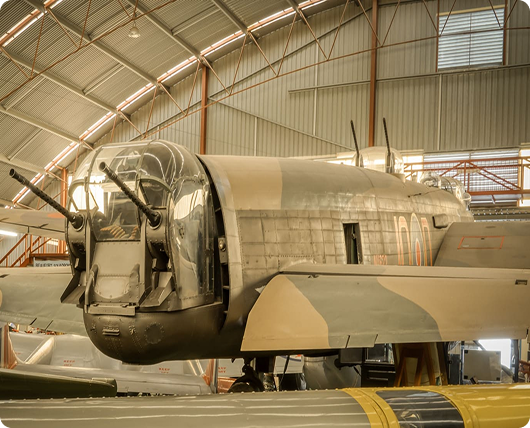
The version displayed at the Aviation Heritage Museum is a Mk VII, one of the final versions produced. Originally intended for use by Tiger Force—the planned Allied air offensive against Japan—it featured tropical modifications including enhanced ventilation and fuel systems suited for operations in the Pacific. Although the war ended before Tiger Force was deployed, the Mk VII remains a testament to how far the Lancaster had evolved by the final stages of the conflict.
Another important variant was the Avro Lancaster Mk X that was built in Canada by Victory Aircraft and powered by Packard-built Merlin engines. These Mk X models supported Commonwealth air operations and demonstrated the global reach of Lancaster production during the war.
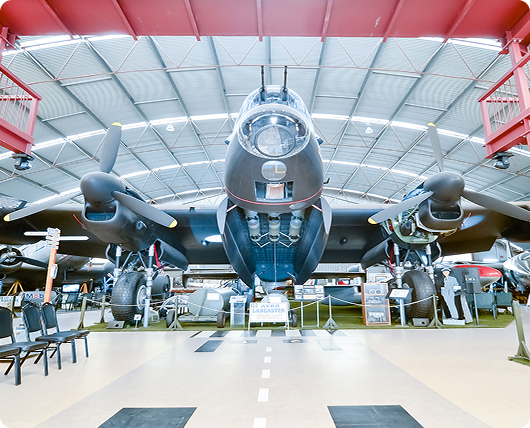
The Role of the Lancaster in Bomber Command
As the backbone of RAF Bomber Command’s strategic offensive, the Avro Lancaster heavy bomber played a defining role in the air war over Europe. From 1942 onward, it became the aircraft of choice for deep-penetration raids into enemy territory—prized for its ability to carry heavy payloads, maintain formation at high altitude and absorb damage while still returning its crew safely to base.
In total, Avro Lancaster WW2 missions accounted for more than 156,000 sorties, dropping over 600,000 tons of bombs. These operations ranged from night-time area bombing of industrial cities to daylight precision strikes, often in hazardous conditions and under intense anti-aircraft fire.
One of the most famous operations was the Dambuster Raid—Operation Chastise—in May 1943. Specially modified Lancasters of 617 Squadron attacked German dams using innovative bouncing bombs, causing widespread flooding and damage to infrastructure. The success of this mission showed just how adaptable the Avro Lancaster bomber was to highly specialised tasks.
The Lancaster was also the only Allied aircraft capable of delivering the 5,400 kg Tallboy and 10,000 kg Grand Slam bombs—massive ordinance designed to destroy fortified bunkers, bridges and submarine pens. This gave Bomber Command a decisive edge in targeting hardened sites.
Each Avro Lancaster bomber crew consisted of seven airmen: pilot, flight engineer, navigator, bomb aimer, wireless operator, mid-upper gunner and rear gunner. These teams operated in tightly coordinated roles, often facing freezing temperatures, enemy fire and long hours in hostile skies. The bond between the crew and their aircraft became a defining element of the Lancaster’s enduring legacy.
Key Specifications & Technical Details
The Avro Lancaster was engineered for performance at scale. The Mk VII on display at the Aviation Heritage Museum represents one of the most refined variants of the aircraft—fitted with power-assisted turrets and other wartime upgrades.
Performance:
- Type: Four-engine strategic bomber
- Top Speed: 462 km/h (287 mph)
- Service Ceiling: 7,470 m (24,500 ft)
- Range: Approx. 4,000 km – offering a notable Avro Lancaster range advantage over many contemporaries
- Powerplant: Four Rolls-Royce Merlin V12 Avro Lancaster engines
- Crew: 7 airmen
Size & Payload Capacity
- Avro Lancaster wingspan: 31 m (102 ft)
- Avro Lancaster length: 21.1 m (69 ft)
- Height: 6.2 m (20 ft)
- Maximum Take-off Weight: ~30,000 kg
- Empty Weight: ~16,740 kg
- Avro Lancaster bomb load: Up to 10,000 kg, including the 12,000 lb “Tallboy” and 22,000 lb “Grand Slam” bombs
- Avro Lancaster dimensions: Optimised for maximum payload while maintaining stability and control at altitude.
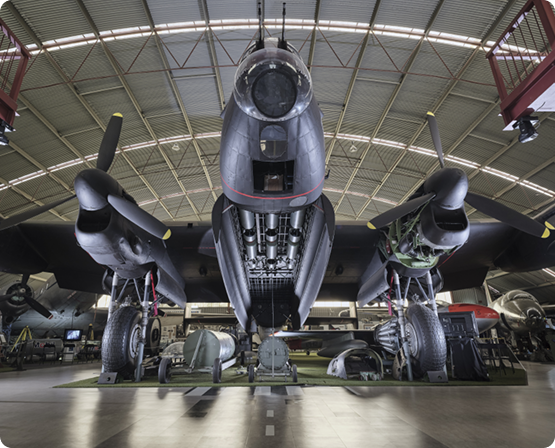
These Avro Lancaster specifications helped establish the bomber as the backbone of Allied air power. Compared to other Allied bombers like the Handley Page Halifax, the Avro Lancaster’s size and payload gave it unmatched reach and impact during WWII.
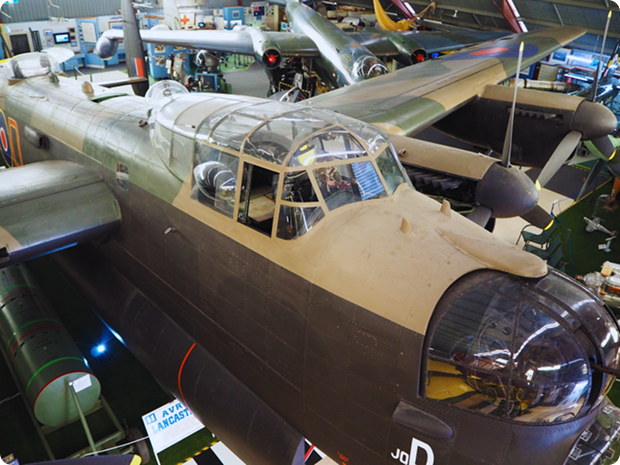
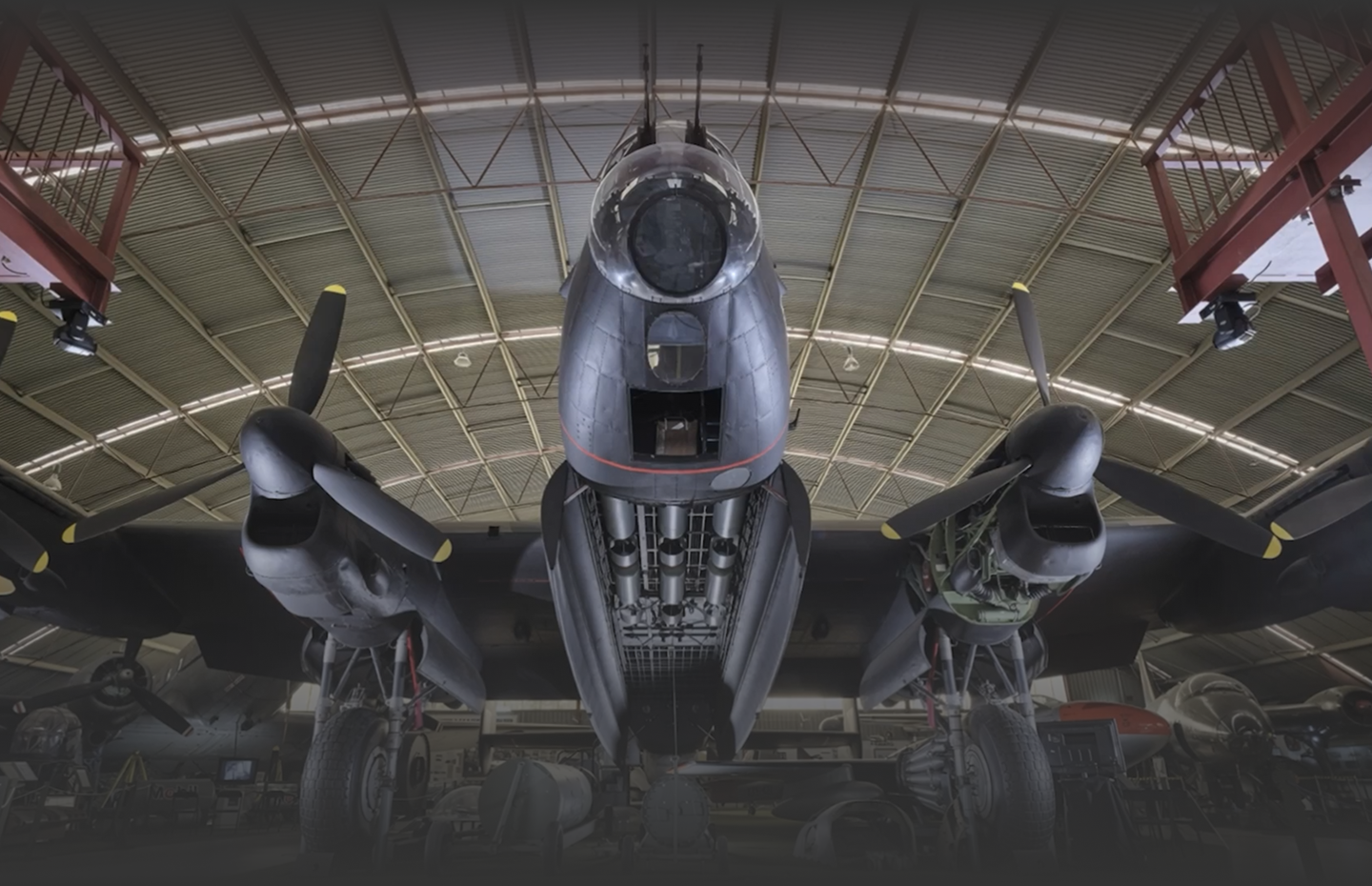
Take the Avro Lancaster Tour
Step inside history with our expert-led Avro Lancaster tour—a highlight of any WWII aircraft tour in Australia. Guided by knowledgeable volunteers and aviation historians, the experience takes visitors beyond static display to explore the aircraft’s story, design and wartime missions.
It doesn’t matter if you’re a first-time visitor or a returning guest; the Lancaster tour offers a rare opportunity to connect with one of the most significant aircraft of the 20th century. Please contact us on 08 9311 4470 for more information or fill out a group booking form.

Visiting Information & Exhibit Highlights
Plan your visit to see one of the rarest examples of the Avro Lancaster aircraft in the world, right here in Western Australia.
Located at the Aviation Heritage Museum in Bull Creek, the exhibit is open daily from 10 am to 4 pm. General admission applies, with discounts available for families, students and group bookings. Pre-booking is recommended for guided tours or large groups.
While exploring the Avro Lancaster Australia display, you’ll also discover other iconic WWII aircraft, including:
- Supermarine Spitfire Mk. 22
- Consolidated Catalina flying boat
- Douglas Dakota C-47 Skytrain
- De Havilland Vampire
Frequently Asked Questions
The Avro Lancaster could carry up to 10,000 kg of bombs, including the massive 12,000 lb Tallboy and 22,000 lb Grand Slam. It had the largest bomb load capacity of any Allied bomber in WWII.