


SUPERMARINE SPITFIRE
Few aircraft are more closely tied to a nation’s survival than the Supermarine Spitfire. During the Battle of Britain, it became a symbol of defiance in the face of overwhelming odds: fast, agile and fearlessly flown against waves of Luftwaffe attacks. Alongside the Hurricane, the Spitfire helped turn the tide of the war and cemented its place in aviation history.
Its elliptical wings, distinct engine sound and sleek silhouette left a lasting impression on pilots and the public. More than just a machine, the Spitfire aircraft became a cultural icon and a source of national pride.
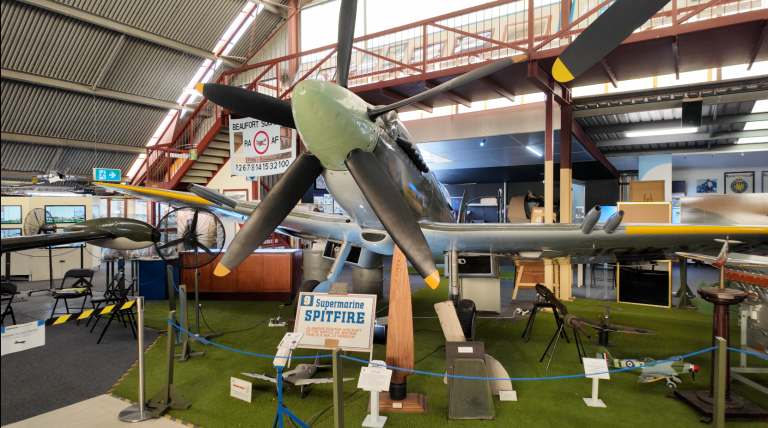
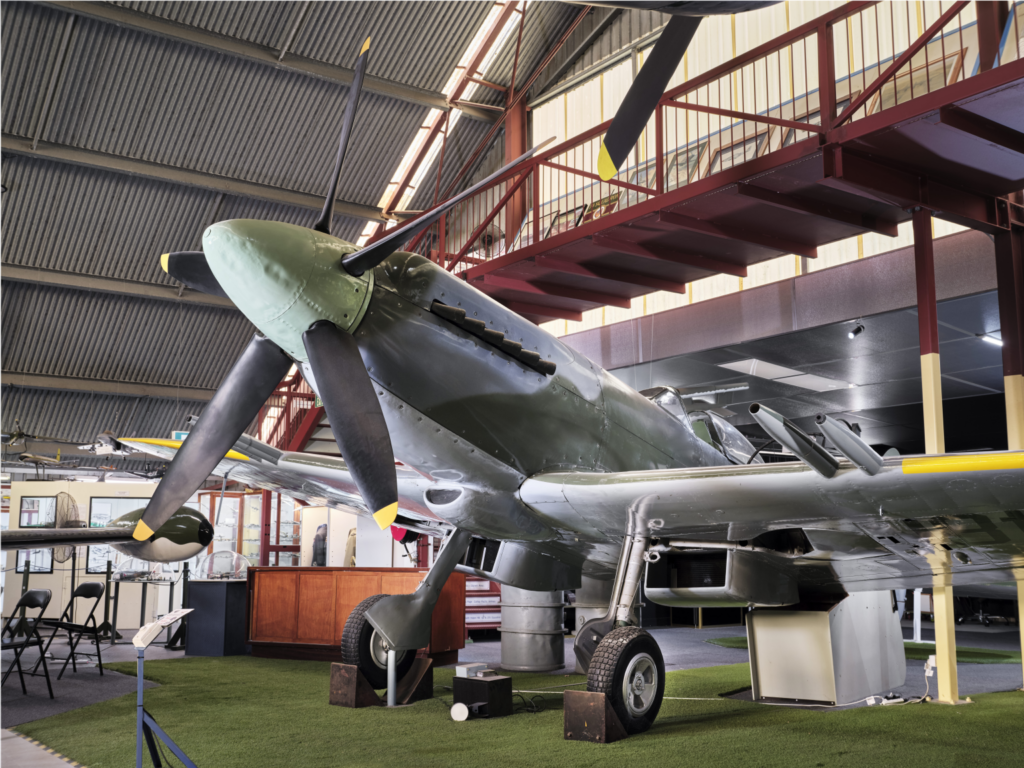
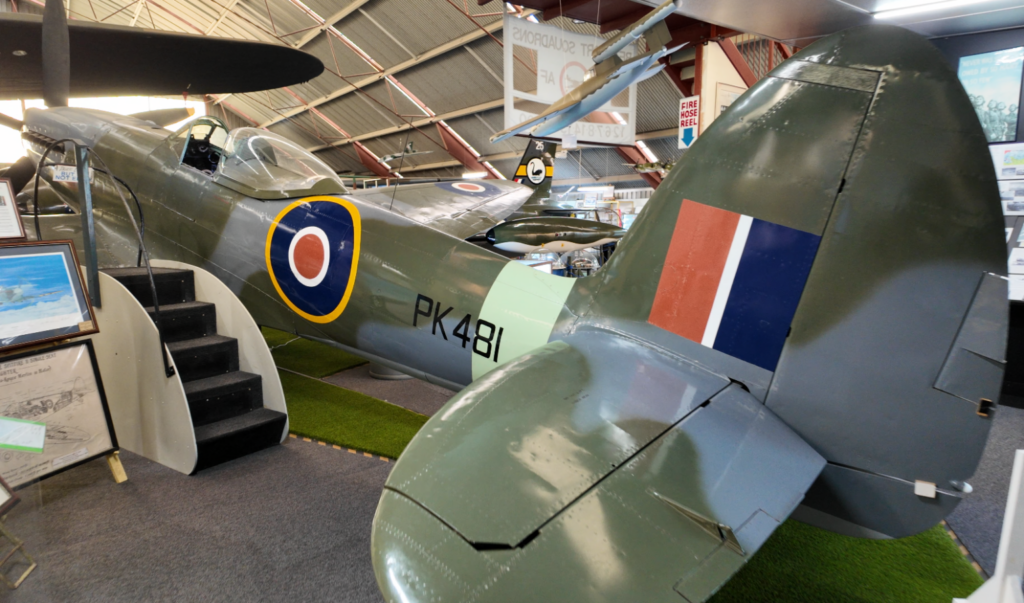
At the Aviation Heritage Museum in Perth, visitors can see this legacy up close. The museum’s Mk 22 Spitfire, PK481, represents a rare post-war evolution of the aircraft that connects frontline combat to enduring memory. Step closer to the fighter who inspired a nation.
A Legend Takes Flight — The History of the Spitfire
The Spitfire fighter planes were born from a vision of speed and elegance, shaped by the genius of British engineer R.J. Mitchell. Developed by Vickers-Armstrong for the Royal Air Force, the aircraft first flew on 5 March 1936 — a sleek, revolutionary machine with an all-metal monocoque frame and distinctive elliptical wings. More than just aesthetically striking, the wing design reduced drag and improved manoeuvrability, setting the stage for one of the most agile fighters of the Second World War.
From its early Mk I configuration to the powerful Mk XIV and beyond, the Spitfire continuously evolved to match the pace of war. It played a defining role in the Battle of Britain, where Spitfires in the Battle of Britain faced off against Luftwaffe bombers and fighters in a clash that would determine the fate of Britain. In the hands of RAF pilots, it proved a match for the Bf 109; nimble, reliable and battle-hardened.
The name “Spitfire” reportedly came from a nickname meaning “fiery-tempered person,” a fitting title for such a spirited machine. Though officially the RAF Supermarine Spitfire, the aircraft quickly transcended its technical identity to become a wartime legend. Today, the Spitfire remains one of the most enduring symbols of resistance, innovation and air superiority in modern history.
Australia’s Spitfires — RAAF and Local Legacy
In 1942, the war reached Australian shores. Japanese forces bombed Darwin, and the RAAF Spitfire was called into action as the nation’s last line of aerial defence. For the first time, Australians were not only fighting abroad, but they were also protecting their home soil.
Across the Pacific, Spitfires served with distinction. No. 1 and No. 79 Squadrons flew defensive sorties over the Northern Territory to intercept incoming raids. No. 457 Squadron — known as the “Grey Nurse” — operated from Morotai and Labuan, flying long-range escort and reconnaissance missions in support of Allied ground forces.
Australia’s frontline fighter was the Spitfire Mark VIII, a tropicalised variant optimised for harsh climates. With improved range, desert camouflage and a modified cooling system, it gave Australian pilots the tools they needed to hold the line.
Spitfire Specifications & Performance
The Spitfire was fast, nimble and deadly. The Mk 22 variant on display at the Aviation Heritage Museum represents one of the final and most advanced evolutions of the Spitfire plane. Key specifications of the RAAF Spitfire:
Technical Information:
- Status: On display
- Type: Single-seat fighter
- Manufacturer: Vickers-Armstrong
- Maiden Flight: 5 March 1936
- Number Built: 20,351 (all variants)
- Primary Users: Royal Air Force (RAF)
Performance Specification:
- Engine: Rolls-Royce Griffon 61 V-12 (2,050 hp)
- Top Speed: 740 km/h (460 mph)
- Range: 1,850 km (1,150 mi)
- Service Ceiling: 13,400 m (44,000 ft)
- Wingspan: 11.27 m (37 ft)
- Length: 10.21 m (33 ft 6 in)
- Loaded Weight: 4,354 kg (9,600 lb)
- Armament: 4 × 20mm Hispano Mk V cannons
Powering the Legend — The Merlin Engine
The early Supermarine Spitfire owed much of its success to the Rolls-Royce Merlin – a liquid-cooled V12 engine that transformed a beautiful airframe into a lethal fighter. From the Mk I onward, the Spitfire Merlin engine gave pilots the speed, agility and climb rate needed to win crucial air battles.
As the war progressed, the Spitfire Merlin evolved. Its horsepower climbed from just over 1,000 to more than 1,600 thanks to improved superchargers and engineering refinements. That extra power meant faster acceleration, better high-altitude performance and a critical advantage in dogfights. Its growling, mechanical roar became the soundtrack of Allied air defence.
Later variants, including the Mk 22, swapped the Merlin for the even more powerful Rolls-Royce Griffon. The Spitfire engine in the Museum’s aircraft pushes out over 2,000 horsepower; a final chapter in a story of constant innovation.
The motor Spitfire gave pilots more than thrust. It delivered confidence, control and the performance edge to outfly the enemy.
Cockpit & Combat — Inside the Spitfire Experience
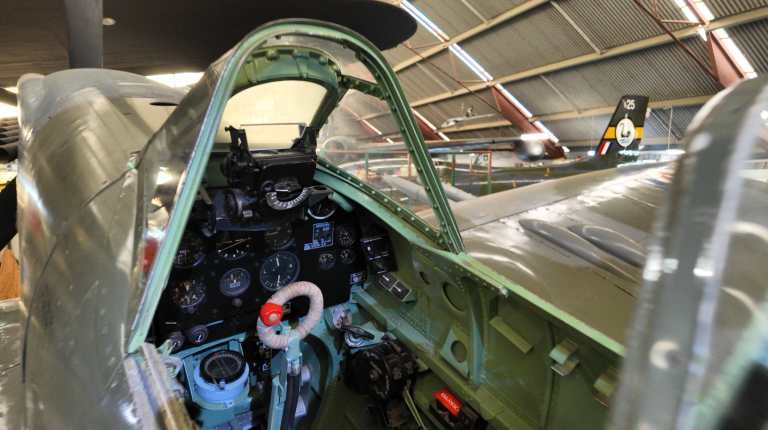
The Spitfire cockpit was a tight, purposeful environment where every inch served a function. In the Mk 22, pilots sat low within the fuselage, surrounded by a curved canopy that offered excellent visibility, which was critical in a turning dogfight. The layout was refined over time for better ergonomics, but space remained minimal. It was just you, the controls and the sky.
Instrumentation filled the front panel: airspeed indicator, altimeter, fuel gauges and engine boost dials. The gunsight aligned perfectly with the aircraft’s four 20mm cannons, while the control stick and throttle gave immediate, responsive feedback.
Flying the World War II Spitfire fighter plane was as physical as it was mental. Pilots felt the resistance of the controls, the thrum of the Griffon engine and the weight of split-second decisions. In combat, that sensation was amplified — vibration through the seat, canopy fogging under stress, the sharp bark of cannon fire.
The Spitfire fighter aircraft wasn’t just flown. It was experienced, remembered and revered by those who took it into battle.
See the Spitfire Up Close at the Aviation Heritage Museum
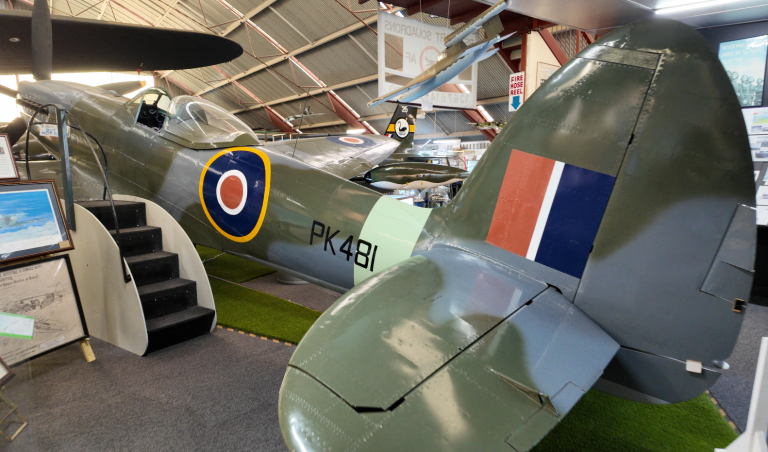
The Spitfire fighter jet on display at the Aviation Heritage Museum is no replica; it’s the real thing. Mk 22 PK481 was delivered to the RAF in September 1945 and served until its withdrawal from service in 1953. Today, it stands preserved in original condition in the North Wing of the Museum, offering a rare and authentic glimpse into the Spitfire’s final era.
This Australian Spitfire is a late-war evolution of the aircraft’s design. The powerful Griffon engine bulge, five-bladed propeller and bubble canopy all signal its advanced performance and post-war pedigree. Every rivet, panel and curve reflects the culmination of nearly a decade of innovation.
As one of the few surviving Mk 22s in existence — and the only one of its kind in Spitfire Australia displays — PK481 is a must-see. This isn’t just a display. It’s a time capsule.
Plan Your Visit to Explore the Spitfire Exhibit
Experience the legacy of the Supermarine Spitfire in person at the Aviation Heritage Museum, located in Bull Creek, Perth. Open daily from 10 am to 4 pm, the Museum offers affordable admission: $15 for adults, $7.50 for children, and $30 for families, with concessions and group bookings available.
Alongside the WWII Spitfire, you’ll also encounter other legendary aircraft, like the Avro Lancaster heavy bomber, Dakota C47 transport and Tornado GR4.
It’s time for you to get closer than ever to the fighter plane Spitfire that helped shape history. From educational displays to immersive tours, every detail is designed to bring the Spitfire plane from WWII to life.
We recommend planning your day via our Visitor Information page to find everything you need to make the most of your visit.
Frequently Asked Questions
Roughly 240 Spitfires still exist today. Most are static displays, though around 60–70 remain airworthy and continue flying at airshows and heritage events worldwide.